
In a photography vault at Y-12, 300,000 original Y-12 photo negatives are filed away in pocket-size envelopes. The pictures document site conditions, buildings, shop tools, and hundreds of employees who have worked at Y-12.
These hard copy photos, plus more than 840,000 digital photos, make up a small part of the collection of original photos, videos, and documents that Y-12 Archivist Natalie H. manages.
“Our photographers take something like 30,000-40,000 photos a year. Graphics and video create an additional 1,000+ items, but the bulk of the collection is photo,” she said.
In 2012, through a program with the University of Tennessee, Y-12 recruited Natalie, then a graduate student, to build a digital library. She was hired full-time in 2013 to manage the VAL, or Visual Asset Library. She was thrilled to be brought onboard.
“The opportunity to build a digital library from scratch is staggering. That’s not something many people get the chance to do,” Natalie said.
Her most recent project to preserve Y-12 history is the VALA, or Visual Asset Library and Archive. The added “A” emphasizes the collection’s archival value.
“While the line is fine, a library collects mass-produced items in which access is the primary focus,” she said. “An archive collects and preserves unique items and the focus is on the preservation aspect.”
The VALA is available only to Y-12 employees, especially as many of the photos document tools and processes. A majority of Y-12 historical photos are already part of publicly-available collections. Natalie’s work largely involves categorizing and interpreting the past for current employees.
“There are loads and loads of photo negatives that are labeled ‘tools’ and ‘areas.’ I do my best to describe these items as accurately as I can within the bounds of classification so future employees can identify how these may be useful to their work,” she said.
Natalie has averaged how much time it takes to encode a single digital image; to scan a historical negative; to log a standard motion picture film, then multiplied it by the size of the current collection, and determined there is about 20 years’ worth of work ahead to address just the backlog before anything else is created. Despite that challenge, she finds immense purpose in her work.
“Y-12 is a major historical site. There are few things in the twentieth century that were bigger than the Manhattan Project,” she said, noting that a photographic archive helps inform decision-making for future generations.
“They [future generations] can handle this site in an environmentally conscious manner to keep the community safe; make well-informed decisions about the stockpile; and be safer – if we have a record of a hazard, maybe a photo of it can keep someone getting hurt.”
The archive, Natalie said, gives her a chance to frame the past, present, and future in a way that is easy to access and understand.
“I want people to understand not just the work – what we have done and are doing here – but to understand the contribution every single worker has made,” she said. “My goal is to be a good caretaker of this collection so I can pass it on to the next archivist in better condition than it was when I found it.”

Natalie wears special gloves to handle the photo negatives in the archive. Even though negatives can be scanned in digitally (rather than developed in a photography darkroom), gloveless handling can irreversibly damage the image.
“Any archivist would tell you they are stewards of a collection, and their job is to make the collection as usable and as preserved as possible for the future. There’s no point in preserving history if it’s useless,” she said.
Hand protection isn’t just to preserve the photos; the edges are incredibly sharp.
“They will cut you,” Natalie said.
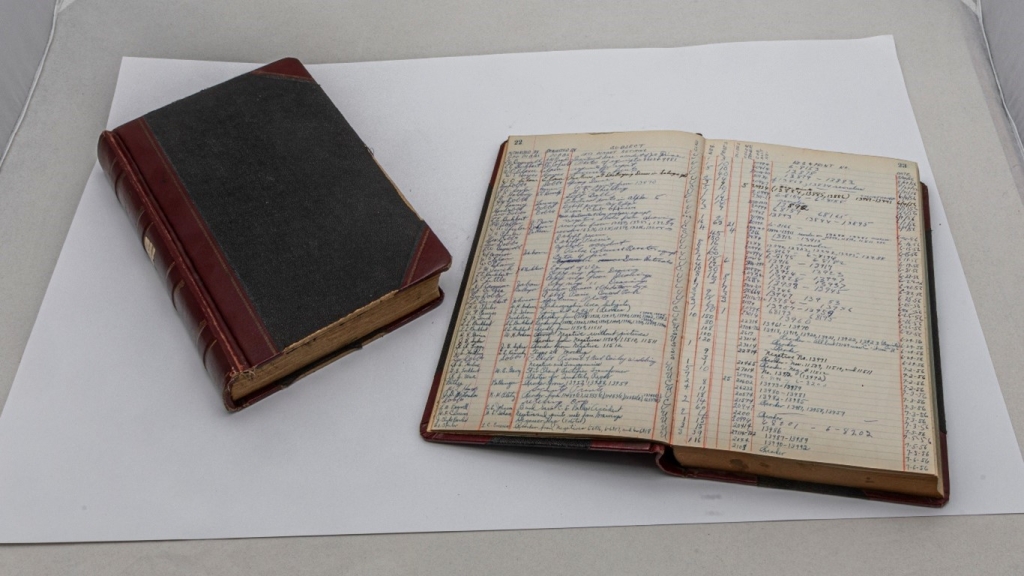
Starting with Manhattan Project Photographer Ed Wescott, Y-12 photo negatives were accompanied by logbooks. The books provided brief details about the photos like date, location, and basic descriptors. But those logbooks stopped in the mid-1980s.
“Starting from 1984, I call that the black hole, there is no logbook for photos, and that goes on until 2004,” Natalie said.
What happened in 2004? The site switched to digital photos.
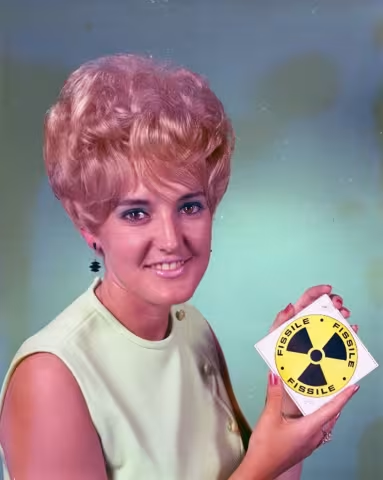
Y-12 hired models to hold hazard signs or pose with weapons at the plant. Natalie has a story about a man who found a picture of his mother, who worked as a model, labeled with a photo number and “Y-12.” In this case, the Communications team asked Natalie to verify the picture was a Y-12 photo. With the number on the label, she was able to find both the record and negatives from 1969, confirming the picture was a Y-12 archival record.
“Without the associated photo number, I would never find it in the negatives,” she said. “It’s not a needle in a haystack. It’s a needle in a needlestack. Most people in the digital archive will never have names, because it’s not something they [early photographers] thought about.”