
Connecting the dots to Y-12 history
One day in August 1945, Bessie Marie Guy put on a polka-dot dress to go to work. That day, in that dress, she became a part of Y-12 history.
In 1945, Bessie Marie, known by her middle name, Marie, was employed at Clinton Engineer Works, then a top-secret Manhattan Project site in Oak Ridge. As Marie and her female colleagues left work one summer afternoon, Manhattan Project photographer Ed Westcott took a quick snapshot. The resulting photo, “Y-12 Shift Change,” became one of the most iconic images of the Manhattan Project.
When the Jack Case Center was built at Y-12, the picture was reproduced as a 20- by 50-foot mural on the cafeteria wall as part of the Ed Westcott photo gallery. Doug C. and his wife, Jenny, see that mural almost every day. They’d seen it before around Oak Ridge and had even snapped a family photo in front of a copy at the American Museum of Science and Energy in town. The Westcott picture at Y-12 holds special significance for them because Doug is Marie’s grandson and Jenny also works on-site.
“That photo is part of the history at Y-12,” Jenny said. “It’s fantastic to see her there and feel proud that she’s part of our family.”
Marie never shared why she was in the background of that photo, because she didn’t talk about her work at Y-12.
“She would tell stories about how she got to work, but she never told stories about being at the plant,” Doug said. “She never even called it Y-12; it was always ‘the plant.’ Even after she left Y-12 and took a job with BellSouth, she talked about her job at the phone company but never talked about what she did here. She was very secretive.”
Marie kept the details of her time at Y-12 so quiet that her family never learned exactly what her job was. Doug didn’t learn more than the words “office” and “medical.” As family lore goes, local Oak Ridge historian Ray Smith reached out to ask Marie for an interview once. He was gathering stories from the women who lived in Oak Ridge and worked at Y-12 during the war years.
“She came down for the interview and they were putting makeup on her; she felt like a celebrity on Hot in Hollywood [an entertainment news show] or something,” Doug said. “Then they turned the cameras on, asked about her work at Y-12, and she gave two-word answers. They weren’t getting anything out of her. She was a rule-follower to the letter.”
When Marie worked on the Manhattan Project, secrecy was part of her job. Signs reminded workers “Silence means security,” and “Loose talk helps our enemy.” Marie lived those mottos. She didn’t take those messages off-site, but she did share another common phrase of the time, first with her grandson and his wife, then with her great-grandchildren.
“When they were little, our kids learned the phrase ‘loose lips sink ships’ from her,” said Jenny. “After she broke her hip at 88, she moved in with us. Our kids knew her as Granny Bessie, and she had a special place in their hearts. She passed down her chicken and dumpling recipe. She taught them to crochet and to garden. She shared gratitude and patience. And she taught them that ‘loose lips sink ships.’”
The kids – now 24 and 22 – still sometimes use the phrase as a family shorthand. Perhaps unsurprisingly, the motto was prevalent in their teens. But as they’ve grown older, the phrase has become more playful. Now, it’s used in family conversations when someone wants to say, “Maybe leave those details out.”
“The phrase was a reality for her, and now, it’s part of our family history,” Jenny said. “Our kids are really proud of her, and they’re really proud of us because we’re following her legacy at Y-12.”
Doug and Jenny came to Y-12 from other careers. Doug was hired first; Jenny came onboard a few years later. Neither Doug nor Jenny predicted they would end up working at the plant. Once they arrived, though, their connection to the site’s history was, quite literally, clearly framed. Marie’s picture is also framed on the wall beside the mural in the cafeteria.
“I wouldn’t quite consider myself following in her footsteps,” Doug said. “I would say it feels more like I’m continuing the story. She was part of the mission then, and we’re part of the mission now. Our family has a story on the outside and a story on the inside, and it looks different from each place. But together, the whole story is that we’ve been a part of something meaningful for 80-plus years.”
When Y-12 officially opened the Jack Case Center in 2007, five of the women pictured in the cafeteria mural were invited to cut the ribbon for the event. Bessie Marie Guy was one of them.
She made sure to wear a polka-dot dress.
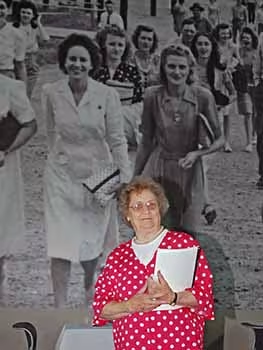
Marie Guy poses in a dress that echoes the polka-dot version she wore to work more than 60 years earlier. (Y-12 archive).
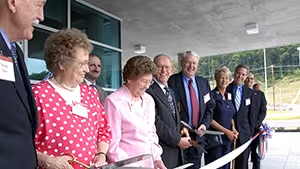
As one of the women pictured in a mural in the Jack Case Center cafeteria, Marie Guy was invited to a ribbon-cutting ceremony with photographer Ed Westcott in 2007. (Y-12 archive).
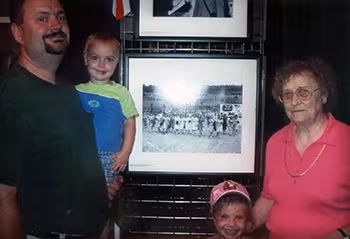
Doug C. and Marie Guy pose for a family photo in front of a copy of Ed Westcott’s “Y-12 Shift Change” at the American Museum of Science and Energy in Oak Ridge. (Submitted)