By Jordan Sherrill –– The Y‑12er spotlight shines on one of our own. It takes all Y‑12 employees to make the mission happen successfully and safely. All views and opinions are the employee’s own and do not necessarily reflect those of CNS.
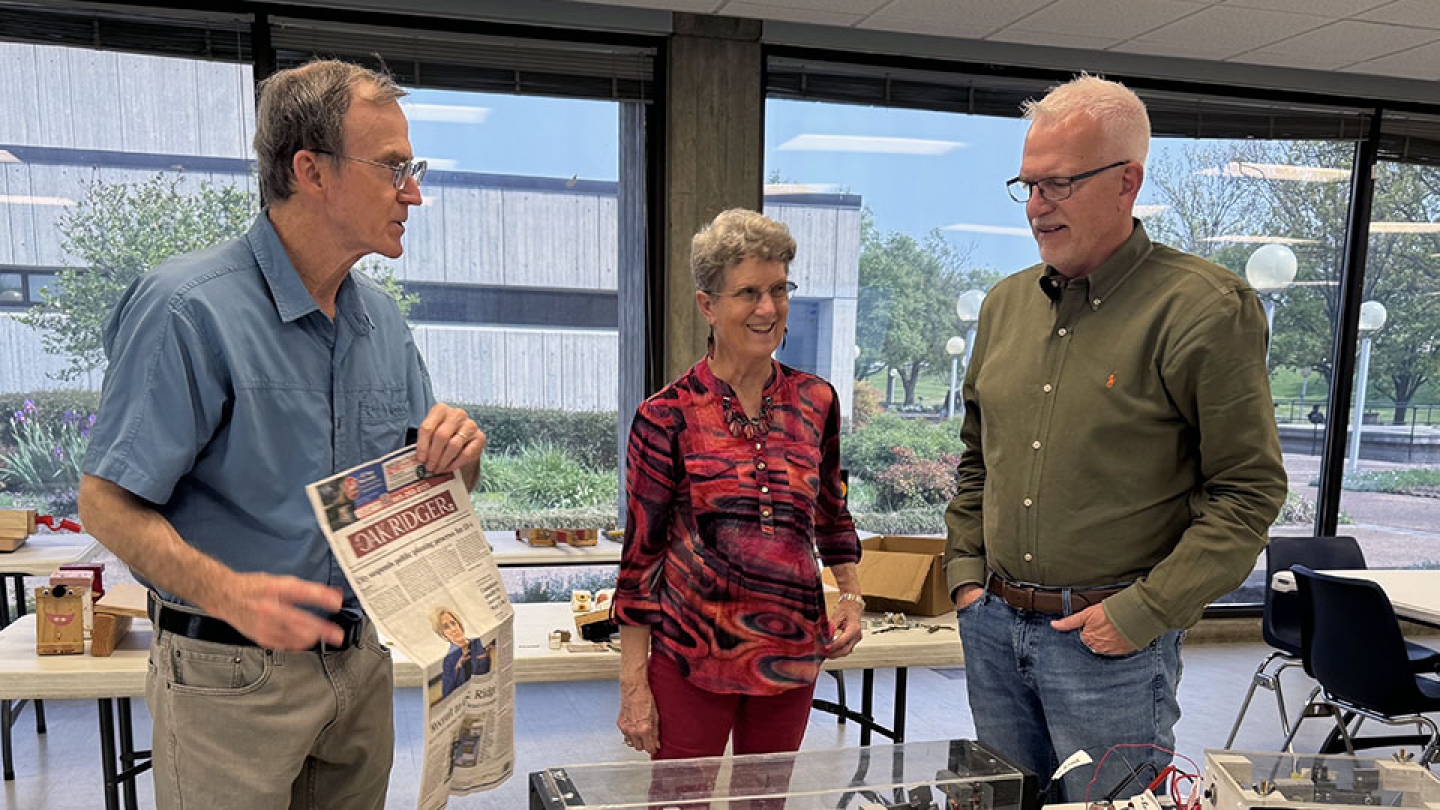
Roane State Nuclear Technology Program Director Joe Stainback, Ph.D. (right), watches as Y-12 computer programmer Ken L. and AMSE education outreach specialist Kris L. demonstrate activities from their new Atoms and Energy class.
The old adage goes, “Do what you love, love what you do.” For Ken L., a Y‑12 Information Solutions and Services computer programmer of 46 years, those are words to live by. He classifies himself as a “lifelong learner,” which is part of the reason he has stayed in a role that has rapidly evolved since his start at the site in 1980.
“Computer programming is a challenging field because there are constantly new projects and systems to work on –– you’re always in learning mode,” Ken said. “People’s toolboxes continue growing as long as they desire them to, so the day you stop wanting to learn is the day you should move on.” He has not yet reached that day.
In addition to continually expanding his own toolbox, Ken uses his computer programming expertise along with his knowledge of the Oak Ridge nuclear industry to provide local students with foundational “tools” in the subjects of science and technology. But he doesn’t do it alone ― his wife, Kris L., education outreach specialist at the American Museum of Science and Energy and former Oak Ridge National Laboratory employee, helps Ken bring his ideas to life.
“We use each other’s strengths and backgrounds (Kris’s in STEM education and mine in computer programming at Y-12) to come together and produce better results. We are a team,” he said.
Thanks to CNS funding from the Y-12 Future Force program, the couple has taught numerous classes that involve computer animations and hands-on activities in all Oak Ridge elementary and middle schools. Their latest class, Atoms and Energy, focuses on nuclear concepts.
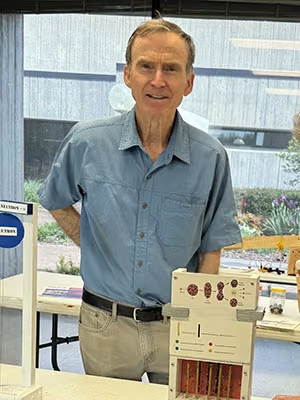
Ken L. poses with one of several handcrafted models of the nuclear fission process shown to students.
“I coded a billiards game that digitally models a nuclear chain reaction of U-235 to U-236,” explained Ken. “In the game, you pull a lever that hits a cue ball to scatter smaller balls, simulating criticality.”
In addition to the computer game (which he equipped with difficulty levels that can be adjusted based on grade level), the class includes physical models and hands-on manipulatives to help students literally “grasp” the concepts. Topics covered explore nuclear energy, fission, low-enriched uranium, types of radiation, and the history of Oak Ridge, including Y-12’s role in World War II and its modern-day missions.
“In my job at Y-12, you have to use modular thinking. I do the same thing to develop these classes,” Ken said. “It’s fun to take a break from programming on a computer to actually being able to apply the concepts in a way that can be shared with others.”
As the 2026–2027 school year gears up, Ken and Kris are ready to get back to teaching their new as well as tried and true classes, supporting local schools’ STEM nights, and participating in various other education events.
How does your outreach work prepare Y-12’s future workforce?
There are so many fields at Y-12 that local kids can go into one day, but the need for competent individuals is a necessity. Our goal is to inspire children in our region to be future leaders in needed science and technology fields by getting them interested at a young age. I love the expressions on their faces when we show them complex concepts through things like our “robots” and interactive models. We use creative methods to teach them about how history, science, and innovation are related.
What’s your favorite memory from your outreach work?
When Kris was showing the billiards game, she told them her husband was a computer programmer and made the game. The kids turned around and gave me a big thumbs up. Their enthusiasm typically starts off slowly and then ramps up by the time they get to the games. Everything clicks then. It’s the reactions that make it all worth it.
How have you seen your outreach work make an impact on the community?
I remember a preschooler documented one of the activities in depth. The fact she watched and drew what she saw without being told was astonishing. I thought, “Woah! This is going to be a future scientist!” Another time, we were giving students “Nobel Peace Prize” stickers after they successfully completed tasks. One student told us, “I’m going to take this home and put it in my science book.” I knew we made a difference that day. Those memories fuel me to keep doing outreach today.